Claude’s AI Watermark and the Patent Risks Founders Should Understand

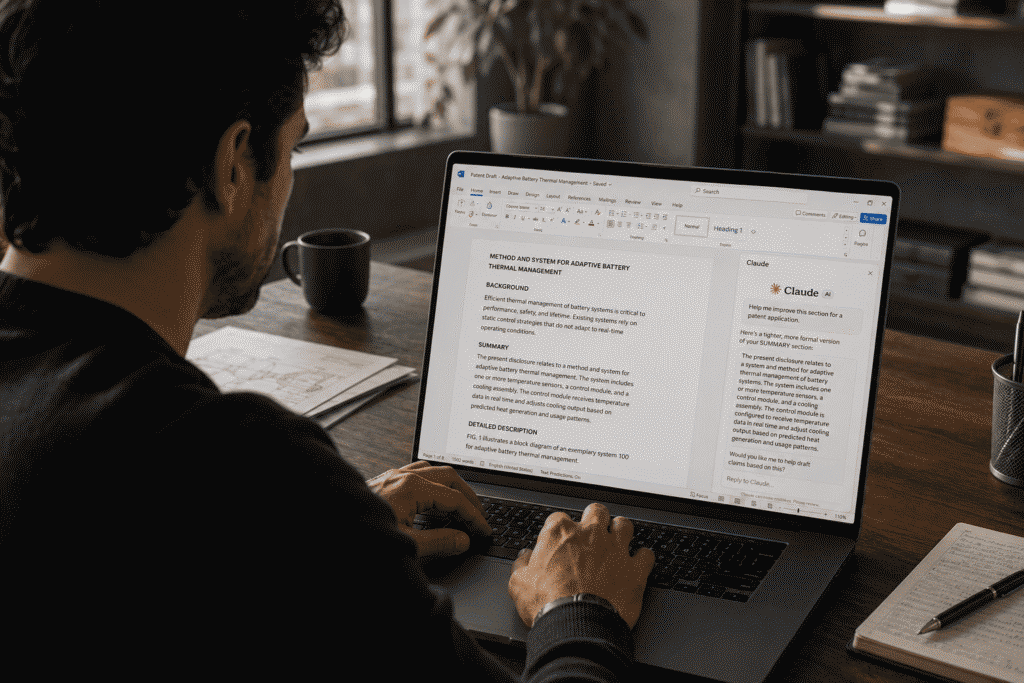
Claude’s AI watermark is not a visible stamp, hidden character, or label attached after writing. Rather, Anthropic describes Claude’s text watermark as an imperceptible mark woven directly into generated text, which means the signal is embedded during text generation rather than added later as ordinary document metadata. Anthropic’s help materials also explain that Claude uses two separate marking methods: embedded text watermarks for generated text and signed provenance metadata for supported generated files. (Anthropic Help Center, “How Claude marks AI-generated content”)
For founders using AI to help prepare invention disclosures, technical descriptions, or patent drafts, the legal issue is not that a watermark makes the work invalid. The issue is that AI involvement may become easier to find, and once it is found, investors, examiners, litigants, or acquirers may ask who conceived the invention, who verified the technical content, and whether confidential information was handled appropriately.
The conversation around AI watermarks can quickly become distorted. A watermark does not prove that Claude invented anything. It does not prove that a patent application is defective. It also does not prove that a human failed to contribute inventive work. Instead, it creates a signal that Claude was likely involved in generating or editing text. Anthropic has separately explained that Claude’s text watermark is based on Google DeepMind’s SynthID-Text approach, which uses detectable patterns in generated language while preserving the reading experience. (Anthropic, “How Claude’s text watermark works”)
Anthropic’s documentation also draws an important line between text watermarking and C2PA provenance metadata. The text watermark is embedded in generated text, while C2PA signed provenance metadata is attached to supported generated files, including certain image and SVG outputs, to record content provenance. (Anthropic Help Center, “How Claude marks AI-generated content”)
This becomes important when a commercially valuable patent is tested years after filing, after the stakes are higher and the drafting history receives closer attention. If watermarked passages appear in a specification or invention record, the question will not be whether AI was used. The better question will be whether you can show that the claimed invention came from human conception, that AI-generated technical details were checked, and that confidential disclosure was not compromised.
Why Claude’s AI Watermark Matters Now
Anthropic announced Claude’s text watermarking in August 2026 as part of a broader content-transparency response to the EU AI Act. Its materials state that Claude uses watermarks embedded in text and signed provenance metadata for certain files, and that the watermarking approach is intended to make AI-generated text machine-detectable while remaining invisible to readers.
The timing matters because many founders have already integrated AI into technical drafting. AI tools are used to summarize invention disclosures, generate background sections, produce alternative embodiments, convert engineer notes into patent-style prose, draft claim examples, and prepare internal materials for counsel. Used carefully, those tools can improve speed and organization. Used casually, they can blur the record of human conception and introduce plausible but unverified technical statements.
The AI watermark changes visibility, not patent law. If no one could previously tell whether a passage came from AI, the use of AI might remain buried in drafts, prompts, revision histories, or internal workflows. A detectable watermark reduces that opacity. In future patent enforcement, diligence, or ownership disputes, a watermark could make it easier to ask targeted questions about the role Claude played in drafting.
That is why the practical response should not be watermark avoidance. The better response is process. A patent that remains defensible when AI involvement is visible is stronger than a patent strategy built around hoping no one can detect the tool.
How Claude’s AI Watermark Works
Claude’s AI watermark is based on Google DeepMind’s SynthID-Text approach. DeepMind’s paper in Nature describes SynthID-Text as a production-ready text watermarking method that preserves text quality, changes only the sampling process, and allows efficient detection without using the underlying language model. (Nature, “Scalable watermarking for identifying large language model outputs”)
In plain terms, the watermark is created while the model chooses words. A language model does not usually select the next word from a single predetermined path. It assigns probabilities to possible next tokens and then samples from that distribution. SynthID-style watermarking changes the sampling process slightly so that, across many token choices, the selected words carry a pattern detectable to someone with the secret key.
The mechanism is often described through tournament sampling. At each step, the system uses a key and the surrounding context to assign pseudo-random values to candidate tokens. Candidate words that the model could plausibly choose are compared, and the process slightly favors choices that contribute to the watermark. To a human reader, the sentence still reads normally because the system is choosing among plausible model outputs rather than inserting visible symbols.
That is why the AI watermark is not a character-count trick. It is not hidden Unicode. It is not metadata pasted into a document. It is a statistical bias in word choice accumulated over a passage. As a result, it can survive copy-paste and light formatting changes, but it should be understood as a probability signal rather than a stamp of authorship.
What the AI Watermark Can and Cannot Prove
A Claude watermark can indicate that Claude was likely involved in producing or editing a passage. It cannot tell the whole authorship story. Anthropic states that its watermark can show likely Claude involvement, but it cannot distinguish between text Claude drafted from scratch and text Claude heavily edited.
That limitation is important for patent work. A founder might write a detailed technical disclosure and use Claude to improve clarity. Another founder might ask Claude to invent embodiments from a thin prompt. Those scenarios create very different legal questions, yet a watermark may not distinguish them. The mark points toward involvement. It does not allocate conception.
The absence of a watermark is also limited. Short passages may not provide enough token choices for a reliable signal. Highly constrained text, such as claim boilerplate, code, formulas, or narrow technical phrasing, may have less room for watermarking because the model has fewer plausible alternatives. Independent research on SynthID-Text has also reported that watermark detectability can degrade under paraphrasing, translation, rewriting, or other transformations. ETH Zurich’s SRI Lab, for example, found SynthID-Text easier to scrub than some other watermarking systems, while still noting detectable features in certain attack settings.
For legal purposes, this means the watermark should be treated as evidence that may prompt questions, not as an answer. It can help identify passages to review, but it does not decide inventorship, enablement, ownership, confidentiality, or validity.
The Patent Risk Is Human Inventorship, Not the Watermark Itself
Under U.S. patent law, AI cannot be named as an inventor. The Federal Circuit held in Thaler v. Vidal that the Patent Act requires an inventor to be a natural person. The USPTO’s revised 2025 inventorship guidance for AI-assisted inventions reinforces that no separate AI-specific inventorship standard applies. The USPTO states that the same legal standard applies regardless of whether AI systems were used, that only natural persons can be inventors, and that ordinary conception remains central.
That rule leaves room for AI assistance. A human can use tools, including AI tools, while still being the inventor if the human conceived the claimed invention. However, the company needs to be able to prove the human contribution. If the most important claimed feature appears to have emerged from an AI-generated passage, a challenger may ask whether any named inventor actually formed the definite and permanent idea of that claimed feature.
The watermark matters because it can make that question easier to ask. A litigant does not need to prove invalidity from the watermark alone. The watermark may simply become a roadmap to discovery: prompts, drafts, revision histories, inventor notebooks, engineer comments, invention disclosure forms, and testimony about who contributed what.
Founders should therefore separate two issues. Using Claude to help draft a patent document is not automatically fatal. Failing to document human conception of the claimed invention can be.
AI-Drafted Patent Text Can Also Create Section 112 Problems
Inventorship is not the only concern. AI-generated technical prose can also create written-description and enablement risk.
Section 112 requires the patent specification to contain a written description of the invention and describe how to make and use it in sufficiently full, clear, concise, and exact terms. In practice, that means the application should show that the inventors possessed the invention and that a skilled person can practice it without undue uncertainty.
Generative AI can produce technical text that sounds confident but is incomplete, speculative, or wrong. In patent drafting, that is dangerous because fluent language can make an unsupported embodiment look real. If AI adds untested configurations, impossible performance claims, unsupported alternatives, or technical mechanisms the inventors did not actually possess, those passages may weaken the application rather than strengthen it.
An AI watermark does not create the Section 112 problem. It may, however, help an opponent locate AI-touched passages and ask whether they were verified. In a high-value dispute, the inquiry may be practical and uncomfortable: who checked this embodiment, what data supported it, where did the limitation come from, and did any inventor understand it at the time of filing?
The safest practice is not to prohibit AI drafting outright. It is to prevent unverified AI-supplied technical content from entering the patent record as if it came from the inventors.
Confidentiality and International Filing Risk Need Separate Attention
Patent teams should also distinguish watermarking from confidentiality. Claude’s AI watermark does not identify the user, organization, or chat, according to Anthropic. But that does not answer the separate question of whether confidential invention information should be submitted to a particular AI system.
The legal issue depends on the tool’s data handling, contractual terms, retention settings, training practices, access controls, and whether the environment is consumer-facing or enterprise-controlled. Submitting an invention disclosure into an AI system is not automatically a public disclosure for patent purposes. However, the analysis can change if the system’s terms permit use, review, retention, or disclosure in ways inconsistent with confidentiality.
That matters especially for international filing strategy. U.S. law contains certain grace-period rules, but novelty can still be affected by prior public availability, and many non-U.S. jurisdictions apply stricter absolute-novelty rules. Section 102 identifies categories of prior art including inventions patented, described in printed publications, in public use, on sale, or otherwise available to the public before the effective filing date, subject to statutory exceptions.
For founders, the practical point is that AI use should be treated as both an IP issue and a data-governance issue. Before uploading invention disclosures, source code, experimental results, customer data, or trade secrets, the company should know what the AI provider can do with that information.
What Founders Should Do Before Using AI in Patent Drafting
The right control is not a ban on AI. It is a record that can withstand scrutiny.
First, document human conception before AI enters the drafting process. Invention disclosures, engineering notes, drawings, lab records, design documents, inventor comments, and meeting notes should show which human contributors developed the claimed features. If the invention later becomes valuable, those records may matter more than the polished application draft.
Second, separate AI drafting assistance from invention generation. Claude can be useful for rephrasing, summarizing, organizing, and identifying questions for counsel. However, if the tool supplies new technical embodiments, alternative architectures, or claim elements, those additions should be reviewed by inventors and patent counsel before they are treated as part of the invention.
Third, track provenance. A simple drafting log can identify which materials came from inventors, which passages were AI-assisted, who reviewed them, and what technical support exists. That record does not need to be theatrical. It needs to be contemporaneous and honest.
Fourth, choose the AI environment deliberately. Patentable information belongs in systems with appropriate confidentiality, retention, data-isolation, access, and no-training protections. Consumer tools, browser plug-ins, unmanaged accounts, and copied chat transcripts can create governance issues that are avoidable.
Finally, avoid making watermark removal the goal. A removed watermark does not prove human conception, and a detected watermark does not defeat a patent. The stronger strategy is to build patent records that remain credible even when AI assistance is visible.
The Timeline Founders Should Keep in Mind
Before disclosure, decide whether any AI system will be used, which environment is approved, and what information may be entered. This is especially important before public demos, investor decks, conference submissions, customer pilots, or international filings.
During drafting, preserve the distinction between inventor-supplied technical content and AI-assisted language. If Claude is used to create alternative embodiments or technical explanations, those passages should be reviewed and supported before filing.
Before filing, counsel should confirm inventorship, assignments, confidentiality, written description, enablement, and whether AI-generated text introduced unsupported material. If international protection matters, the novelty and confidentiality analysis should be handled before any broad disclosure.
After filing, keep the drafting record. If the patent later becomes important in financing, acquisition, licensing, or litigation, the company may need to show how the invention was conceived and how AI-assisted drafting was controlled.
Claude’s AI Watermark Is a Visibility Problem for Weak Process
The Claude AI watermark does not make AI-drafted patents invalid. It does not replace inventorship law. It does not prove that Claude conceived an invention. It does not establish that a patent specification is enabled or unsupported. It simply makes AI involvement easier to detect in some text.
For well-managed patent programs, that should be manageable. If the company can show human conception, verified technical content, proper assignments, careful confidentiality, and clean drafting provenance, the watermark is less threatening. It may show that AI helped with language, but it should not undermine the invention record.
For companies using AI casually, the risk is different. If no one can explain where a claimed feature came from, whether the inventors possessed it, whether the AI output was verified, or whether confidential information was protected, the watermark becomes a starting point for harder questions.
The legal risk is not the mark. The legal risk is being unable to defend the process behind the document.
His degree in Electrical and Computer Engineering has helped him serve technology companies of all sizes including Microsoft, Cisco, Cox, AT&T, General Electric, Georgia Institute of Technology, and Coca Cola.
Eliezer’s technological knowledge, entrepreneurial expertise, and nuanced perspective on technological innovation, has attracted national media coverage, of the likes of NPR, CNN, and The International Business Times. Eliezer also applies his wide-ranging experiences as an Advisor to the Atlanta Tech Village, where he provides guidance to a community of 120 startup companies.
- Claude’s AI Watermark and the Patent Risks Founders Should Understand - September 2, 2026
- USPTO’s Semiconductor Technology Pilot Program - December 18, 2023
- First-Time Filer Expedited Examination Pilot Program (FTEEP) - October 17, 2023