Appeals Gain Strategic Weight as USPTO Backlog Declines

A System Under Pressure Has Begun to Rebalance
If your company relies on patents to support product development, valuation, or competitive positioning, the pace of examination determines how quickly those rights convert into business assets. For years, that pace moved under the weight of growing inventory and extended timelines. That pressure defined how your legal team approached prosecution.
Recent USPTO data signals a different trajectory. Application inventory has begun to contract from its peak. Appeals backlog has fallen to levels not seen in two decades. At the same time, pendency metrics reveal where pressure still exists within the system.
These shifts demand a recalibration of how your company approaches prosecution strategy. The system is moving, although it moves unevenly across stages. As a result, your decisions carry greater influence over timing and outcome.
The Inventory Decline Signals a Structural Shift in Examination Throughput The decline in unexamined patent applications reflects a measurable change in throughput. As of March 2026, the unexamined inventory stands at 783,414 applications. This figure marks a reversal from prior growth trends that had pushed the backlog toward sustained expansion.
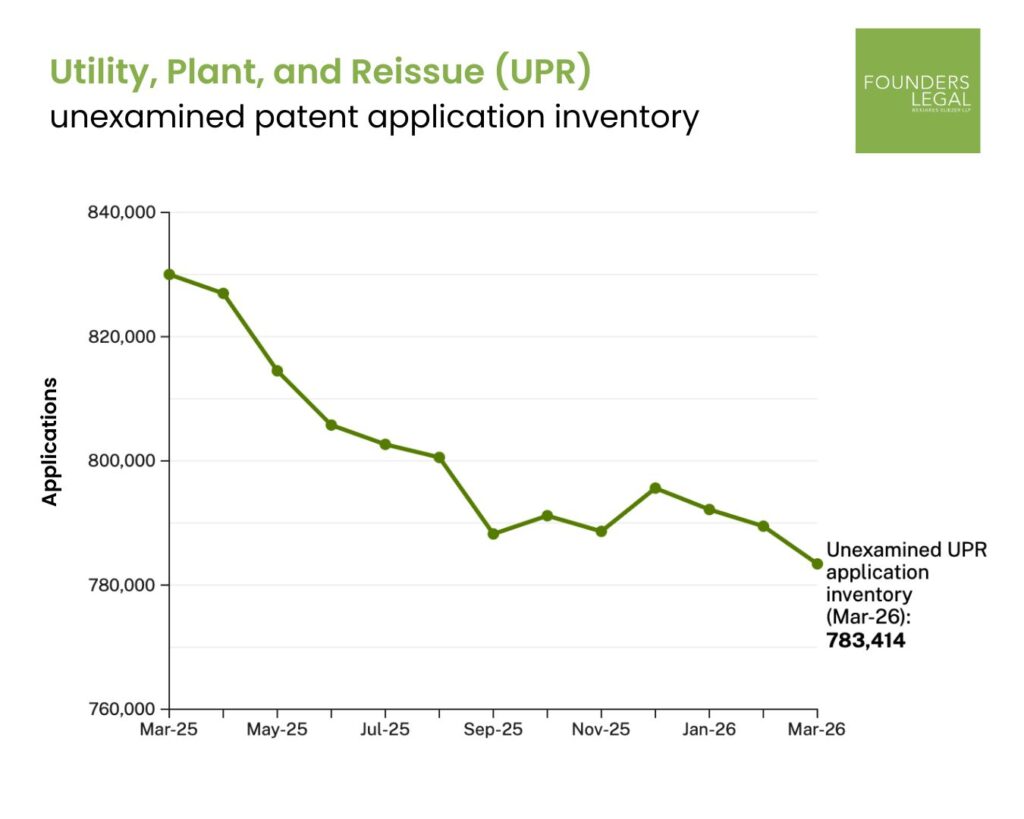
This reduction signals more than administrative progress. It indicates that examination capacity is beginning to align with filing volume. That alignment carries direct implications for how your applications move through the system.
Earlier engagement with examiners becomes more predictable. First office actions arrive within a tighter band of expectations. Consequently, your ability to plan around prosecution timelines improves.
However, this improvement introduces a secondary effect. Faster movement through early stages requires your team to respond with greater precision. Delays within your own workflow can offset gains created by the system.
Total Application Volume Reveals the Scale of Strategic Exposure
The total application inventory stands at approximately 1.25 million applications. This figure captures the full scope of pending matters across all stages of prosecution.
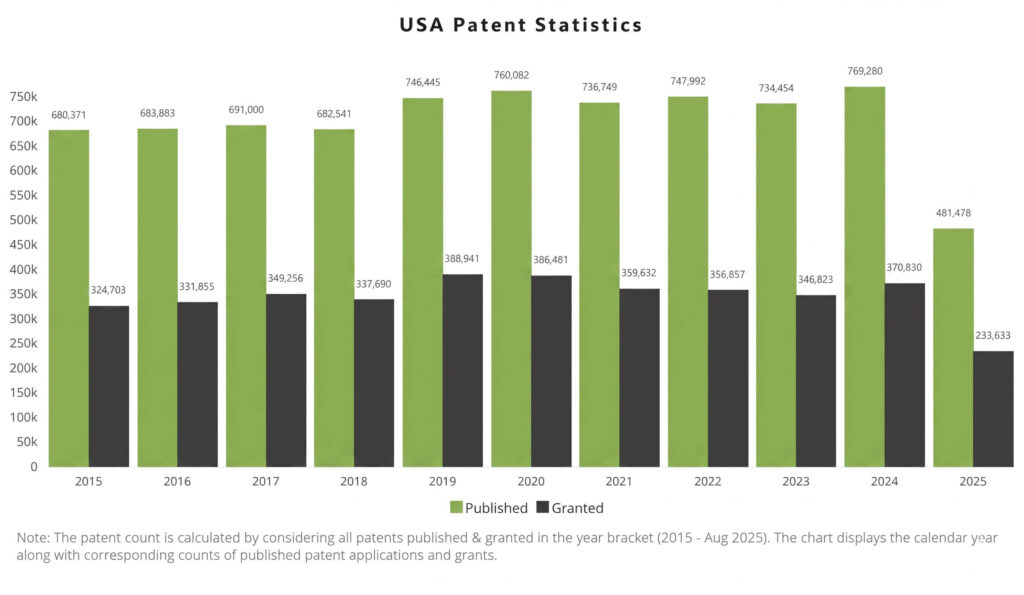
For your company, this number represents more than system scale. It reflects the competitive density within your technology domain. Each application competes for examination resources, and each granted patent shapes the landscape in which your products operate.
As the system processes this volume more efficiently, outcomes across your portfolio accelerate. Competitor patents move toward issuance with greater speed. Your own filings progress under similar conditions.
This dynamic raises the stakes of early-stage decisions. Claim scope, specification support, and prosecution posture determine how your assets emerge within a more responsive system.
First Office Action Pendency Defines Where Pressure Persists
Despite improvements in inventory, first office action pendency remains elevated at approximately 22.1 months. This metric defines the time between filing and the initial substantive response from the USPTO.
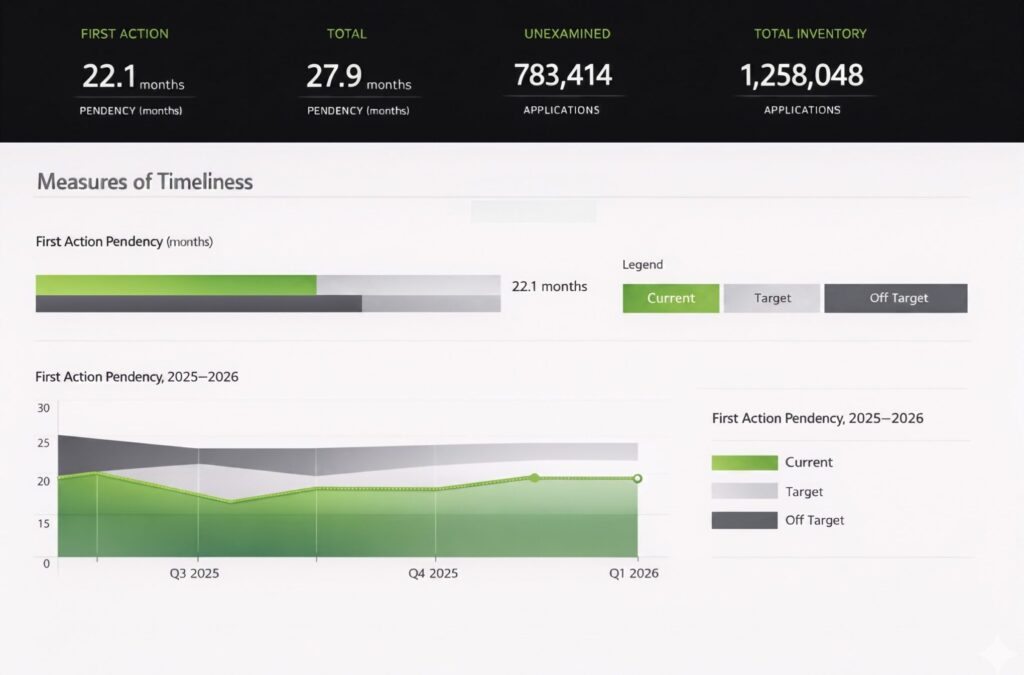
This figure reveals where pressure continues to exist. While inventory declines indicate improved throughput, the initial examination stage still carries a meaningful delay.
For your strategy, this creates a dual reality. On one hand, the system is clearing accumulated volume. On the other hand, the entry point into examination still requires long-term planning.
As a result, your filing decisions must account for this lag. When a patent supports a near-term business objective, timing strategies such as prioritized examination or continuation planning require careful consideration.
Pendency pressure does not affect every technology category equally. Certain areas, particularly business method patents, experience longer and more variable examination timelines.
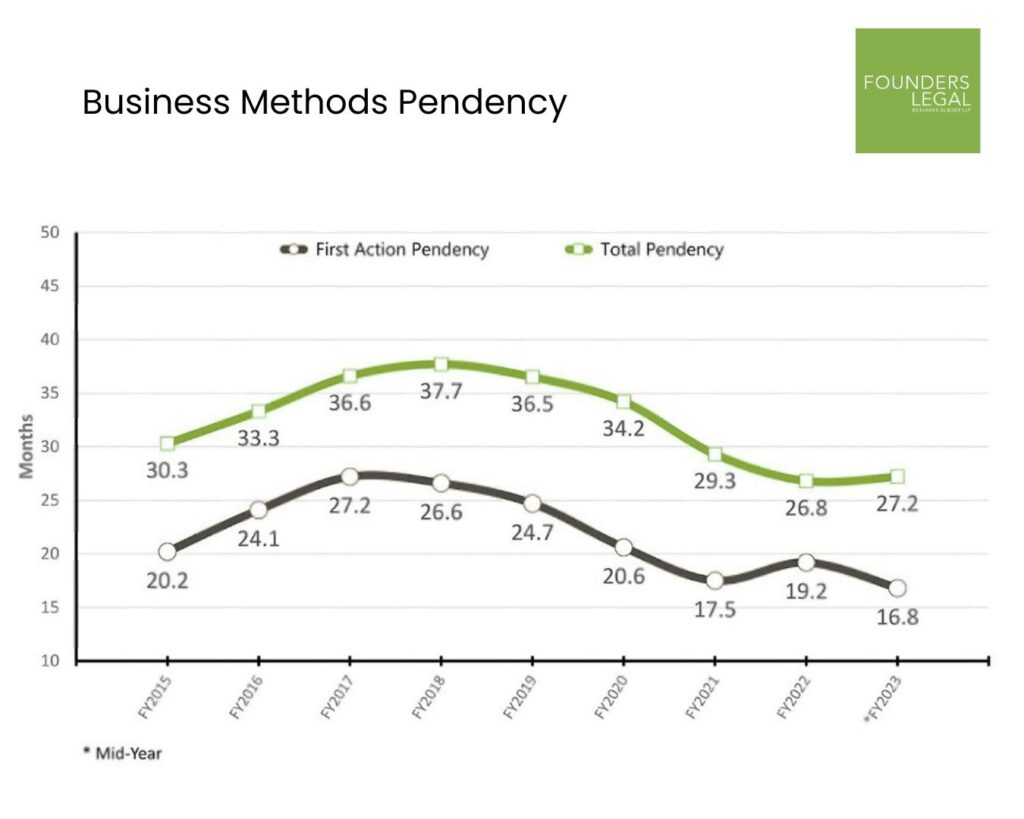
The divergence between first action and total pendency in this category illustrates how examination complexity extends timelines and influences prosecution strategy.
Appeals Backlog Reduction Changes the Escalation Equation
While early-stage pendency remains significant, the appeals landscape has shifted in a different direction. The PTAB appeals inventory has dropped below 2,000 cases, marking the lowest level in two decades.
This development carries strategic weight for your company. Appeals historically introduced extended timelines that discouraged escalation. That assumption shaped how your legal team approached examiner disagreements.
With a reduced backlog, the expected duration of an appeal changes. Escalation becomes a more viable pathway for resolving disputes over claim scope or prior art interpretation.
This shift influences negotiation dynamics during prosecution. When an examiner maintains a position, your ability to escalate carries greater credibility. The pathway to Board review now aligns more closely with business timelines.
Examination Strategy Must Adjust to a Faster System
Historically, prosecution strategy accommodated delay. Teams relied on iterative engagement with examiners, often extending discussions across multiple rounds. Continuation practice provided flexibility, while appeals remained a distant option.
The current environment requires a different approach. As inventory declines and appeals accelerate, each decision within prosecution carries greater immediate impact.
Your team must evaluate whether continued negotiation advances the application or whether escalation provides a more efficient route to resolution. This decision depends on the strength of the record, the importance of the claims, and the timing of the underlying business objective.
A faster system rewards decisiveness. It favors strategies that align legal action with commercial priorities.
Portfolio Management Gains Strategic Importance
As examination timelines compress unevenly across stages, portfolio management becomes a central function within your IP strategy.
Each application within your portfolio occupies a different position within the system. Some await first action. Others progress through examination. Still others approach appeal or allowance.
Coordinating these positions requires a comprehensive view of timing and value. Applications tied to critical technologies demand active management. Those with lower strategic importance may follow a more passive path.
The reduction in backlog amplifies the impact of these choices. Faster movement means that outcomes arrive sooner, which in turn influences competitive positioning.

The Cost of Misaligned Strategy Increases
When system conditions shift, strategies built on prior assumptions can create inefficiencies. A prosecution approach designed for a slower environment may introduce unnecessary delay within a faster system.
For example, extended negotiation cycles with an examiner may consume time that could be better allocated to escalation. Similarly, delayed decisions on claim amendments may reduce the likelihood of achieving optimal scope within a narrower window.
These inefficiencies carry tangible costs. They affect time to grant, enforcement readiness, and the ability to support business initiatives.
Aligning your strategy with current system dynamics reduces these costs and improves overall portfolio performance.
Data Visibility Enables Real-Time Strategic Adjustment
The USPTO dashboard provides continuous visibility into key metrics such as inventory, pendency, and throughput. For your company, this data functions as an operational tool rather than a static reference.
Monitoring these metrics allows your legal team to adjust strategy in response to system conditions. When inventory declines, you can anticipate faster movement. When pendency increases in specific art units, you can adjust expectations accordingly.
This level of visibility supports proactive decision-making. It allows your team to act based on current conditions rather than historical assumptions.
AI Expands Your Team’s Capacity to Operate Within a Faster System
As the system moves with greater responsiveness, your legal team faces increased demands on timing and output. Patent prosecution involves continuous drafting, analysis, and argument development. These tasks operate within a language-driven framework.
Large language models enhance your team’s ability to perform these functions at scale. They process technical and legal information efficiently, enabling faster preparation of responses and more consistent argumentation.
In practical terms, this capability supports your ability to engage effectively within tighter timelines. It allows your team to respond to office actions with greater speed while maintaining quality.
Moreover, AI-driven workflows increase output per attorney, enabling your organization to manage a larger portfolio without proportional increases in headcount.
This operational advantage becomes critical as the system accelerates.

Appeals Strategy Now Serves as a Lever for Timing Control
With reduced backlog at the PTAB, appeals serve a different role within your strategy. They function as a lever for controlling timing rather than a mechanism of last resort.
When an application reaches an impasse during examination, an appeal can advance resolution within a defined timeframe. This creates alignment between legal action and business objectives.
For example, when a patent supports a product launch, the ability to reach a decision through appeal can influence market entry strategy. Similarly, in licensing or investment contexts, faster resolution enhances the value of the asset.
This shift requires your team to evaluate appeals earlier in the prosecution process. Waiting until late stages may reduce the strategic benefit.
Strategic Coordination Across the Portfolio Drives Competitive Advantage
As system dynamics evolve, coordination across your portfolio becomes a source of competitive advantage. Each application contributes to a broader strategy that supports your company’s position within its industry.
Aligning filing strategies, prosecution tactics, and escalation decisions ensures that your portfolio develops in a cohesive manner. This alignment supports consistent claim scope, efficient use of resources, and timely outcomes.
The reduction in backlog and appeals inventory amplifies the impact of this coordination. Faster system movement rewards organizations that operate with precision and foresight.
The Strategic Question Facing Your Organization
The current environment presents a clear question for your leadership team.
Does your patent strategy reflect how the USPTO operates today, or does it reflect how the system functioned under prior backlog conditions?
Answering this question requires an honest assessment of your processes, assumptions, and decision-making frameworks.
A strategy aligned with current conditions positions your company to secure rights efficiently, respond to competitive pressures, and support business objectives with greater certainty.
A strategy grounded in outdated assumptions risks delay, inefficiency, and missed opportunities.

In particular, Kevin specializes in preparing and executing strategies for obtaining domestic and international patent protection for clients’ inventions.In addition to his experience preparing and prosecuting patent applications, Kevin has experience with post-grant proceedings before the U.S. Patent and Trademark Office.Kevin also has experience working with inventors to help determine patentability and points of novelty of their inventions.
- Patent Enforcement Strategy After Apple’s $5.7 Billion Verdict - October 12, 2026
- How the U.S. Patent Process Works From Invention to Issuance - September 24, 2026
- Trade Secret vs Patent: How to Protect Technology Before Disclosure - September 23, 2026
Sources:
USPTO Patent Dashboard
USPTO Pendency Data (First Office Action, Total Pendency)
USPTO Unexamined Patent Application Backlog Update